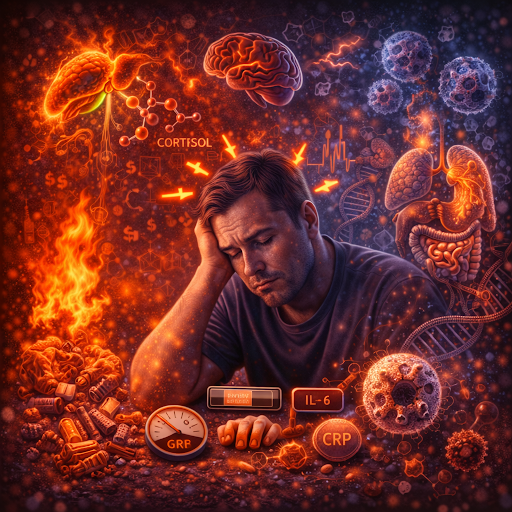
Stress is often framed as a psychological experience, shaped by workload, relationships, or life events. It is discussed in terms of mindset, coping skills, or emotional resilience. While these dimensions matter, they capture only part of the picture. Stress is also a deeply biological phenomenon, one that reshapes physiology when it becomes chronic.
Short-term stress responses are adaptive. They mobilize energy, sharpen focus, and support survival. Constant stress exposure, however, pushes these same systems beyond their intended design. Over time, the body pays a biological price for remaining in a prolonged state of alert. Understanding chronic stress physiology reveals how persistent stress alters hormonal signaling, metabolism, immune regulation, and tissue repair in ways that accelerate dysfunction across systems.
Rather than being confined to mental health, chronic stress operates as a whole-body condition with far-reaching consequences.
Contents
- 1 Stress as a Coordinated Physiological Response
- 2 Cortisol and Energy Redistribution
- 3 Nervous System Imbalance
- 4 Immune Consequences of Constant Stress
- 5 Inflammation as a Stress Byproduct
- 6 The Brain Under Chronic Stress
- 7 Digestive and Metabolic Disruption
- 8 Cellular Repair and Accelerated Aging
- 9 Stress Without Recovery
- 10 Why Symptoms Are Often Misattributed
- 11 A Systems View of Stress
- 12 Rethinking Stress as a Biological Load
Stress as a Coordinated Physiological Response
The stress response is orchestrated primarily through the hypothalamic–pituitary–adrenal axis and the sympathetic nervous system. When a threat is perceived, these systems release hormones such as cortisol, adrenaline, and noradrenaline. Together, they increase heart rate, elevate blood glucose, redirect blood flow, and suppress nonessential functions.
In acute situations, this response is tightly regulated. Once the threat passes, hormonal levels return to baseline, and restorative processes resume. The body cycles between activation and recovery.
Problems arise when stressors are continuous or when recovery is incomplete. In modern environments, psychological stressors often lack clear endpoints. Deadlines, financial pressure, social tension, and constant digital stimulation keep stress pathways partially activated throughout the day.
This persistent activation transforms a protective response into a chronic physiological state.
Cortisol and Energy Redistribution
Cortisol plays a central role in chronic stress physiology. It ensures that energy is available by increasing glucose production and mobilizing fuel stores. In the short term, this supports performance under pressure.
With constant stress exposure, cortisol remains elevated or becomes dysregulated. This alters how energy is handled at the cellular level. Blood glucose stays higher for longer periods, insulin signaling becomes impaired, and fat storage patterns shift toward visceral depots.
Research summarized by the National Institutes of Health shows that prolonged cortisol elevation contributes to insulin resistance, muscle breakdown, and altered lipid metabolism. These changes reflect a system locked in energy mobilization mode without adequate recovery.
Over time, this metabolic strain contributes to fatigue, weight resistance, and reduced physical resilience.
Nervous System Imbalance
Chronic stress also reshapes the balance between the sympathetic and parasympathetic nervous systems. Acute stress appropriately increases sympathetic activity. Recovery depends on parasympathetic activation, which supports digestion, repair, and immune regulation.
When stress is constant, the sympathetic tone remains elevated. Heart rate variability declines, digestion slows, and restorative signaling is suppressed. This imbalance is not merely a feeling of being “on edge.” It reflects measurable changes in autonomic function.
Persistent sympathetic dominance increases cardiovascular strain and reduces the body’s ability to transition into repair states. This helps explain why chronic stress is associated with hypertension, gastrointestinal issues, and sleep disruption.
Immune Consequences of Constant Stress
The immune system is highly sensitive to stress hormones. Acute stress can temporarily enhance certain immune responses. Chronic stress has the opposite effect.
Prolonged cortisol exposure suppresses immune surveillance and alters inflammatory signaling. Some immune pathways become underactive, while others remain chronically activated. This imbalance contributes to both increased infection risk and low-grade systemic inflammation.
Studies discussed by Harvard Health Publishing highlight that chronic stress is associated with impaired immune regulation and delayed recovery from illness. This dual effect underscores why stressed individuals may feel run down while simultaneously experiencing inflammatory symptoms.
Immune dysregulation is not a side effect of stress. It is a core feature of chronic stress physiology.
Inflammation as a Stress Byproduct
Low-grade inflammation is one of the most consistent biological markers of chronic stress. Stress hormones influence inflammatory pathways directly and indirectly through metabolic effects.
Elevated glucose and free fatty acids promote inflammatory signaling. Sleep disruption, common under stress, further increases inflammatory markers. Over time, the body exists in a pro-inflammatory state that damages tissues and interferes with normal signaling.
This inflammatory load contributes to joint pain, cardiovascular disease risk, neuroinflammation, and metabolic dysfunction. Importantly, it often develops without obvious symptoms, allowing damage to accumulate quietly.
The Brain Under Chronic Stress
The brain both drives and suffers from chronic stress. Prolonged exposure to stress hormones alters brain structure and function, particularly in regions involved in memory, emotional regulation, and decision-making.
The hippocampus, critical for memory and learning, is especially sensitive to cortisol. Chronic exposure can impair neurogenesis and synaptic plasticity. The prefrontal cortex, responsible for executive function, may show reduced activity under sustained stress, impairing focus and impulse control.
At the same time, stress sensitizes the amygdala, increasing threat perception. This creates a feedback loop in which the brain becomes more reactive, perpetuating stress responses even in low-risk situations.
Digestive and Metabolic Disruption
Digestive function is often compromised under chronic stress. Blood flow is redirected away from the gastrointestinal tract, slowing digestion and impairing nutrient absorption. Stress hormones also influence gut motility and microbial balance.
Over time, these changes can affect gut barrier integrity, increasing systemic exposure to inflammatory molecules. This gut–stress connection links psychological stress with digestive symptoms and metabolic inflammation.
Educational resources focused on metabolic health, including those available on Dr. Berg’s website, frequently emphasize stress as a hidden driver of digestive and metabolic dysfunction rather than a separate mental-health concern. You can explore this integrated perspective at https://www.drberg.com/
Cellular Repair and Accelerated Aging
One of the less visible costs of constant stress exposure is reduced cellular repair. Stress suppresses processes such as autophagy and DNA repair, prioritizing immediate survival over maintenance.
When repair mechanisms are consistently downregulated, cellular damage accumulates. Mitochondrial efficiency declines, oxidative stress increases, and tissues lose resilience. These processes contribute to accelerated biological aging.
From this perspective, chronic stress physiology acts as an aging accelerator, compressing the timeline over which functional decline occurs.
Stress Without Recovery
A defining feature of chronic stress is not intensity but duration. Even moderate stress becomes damaging when recovery is insufficient.
Modern lifestyles often remove natural recovery signals. Sleep is shortened, meals are rushed, movement is limited, and mental stimulation continues late into the evening. Without adequate parasympathetic activation, stress responses never fully shut down.
This recovery deficit explains why individuals can feel exhausted despite not engaging in extreme physical effort. The body remains in a semi-activated state, consuming resources without replenishment.
Why Symptoms Are Often Misattributed
The biological effects of chronic stress develop gradually. Fatigue, weight changes, brain fog, and digestive issues are often attributed to aging, diet, or lack of discipline rather than stress physiology.
This misattribution delays recognition of stress as a root cause. Interventions may target symptoms without addressing the underlying activation state that drives them.
Understanding chronic stress physiology reframes these symptoms as adaptive responses that have become maladaptive through persistence.
A Systems View of Stress
Viewing stress through a systems lens reveals why isolated interventions often fail. Treating sleep issues without addressing stress hormones or addressing diet without restoring nervous system balance, produces limited results.
Chronic stress affects energy regulation, immune signaling, neural function, and repair processes simultaneously. Effective strategies must therefore consider the entire physiological context.
This systems perspective aligns with a growing shift in health science away from siloed models and toward integrated regulation.
Rethinking Stress as a Biological Load
Stress is often framed as something to manage mentally. Chronic stress physiology suggests it should also be viewed as a biological load that accumulates over time.
This load shapes metabolic health, immune resilience, and aging trajectories. Reducing it requires restoring cycles of activation and recovery rather than eliminating stress entirely.
The biological cost of constant stress exposure extends far beyond emotional discomfort. It reshapes metabolism, suppresses repair, dysregulates immunity, and accelerates aging through persistent activation of survival pathways.
Understanding chronic stress physiology provides a framework for explaining why stress-related symptoms span so many systems and why they persist even when individual stressors seem manageable.